
Fremont County Probate Court Route
Probate in Fremont County is handled through the Magistrate Division of the District Court. Idaho's court structure places probate matters, wills and estates, guardianships, and conservatorships under magistrate jurisdiction. The same local courthouse also handles other magistrate matters such as traffic, misdemeanors, small claims, evictions, family law, and juvenile cases, so searchers should identify the case type before asking for a file.
Fremont County probate records can include wills and codicils admitted to probate, informal or formal probate applications, appointment of a personal representative, letters testamentary, letters of administration, notices, inventories, accountings, bond requests, orders, final distribution, and guardianship or conservatorship filings. The county Recorder also records wills admitted to probate and recorded instruments affecting real property, which creates a second local access channel outside the court case file.
Fremont County Magistrate & District Courts
151 W 1st North
St. Anthony, ID 83445
208-624-7200
Monday-Friday 8 am-5 pm; court office closed during lunch per staff directory
Fremont County Probate Terms
Probate words often point to the exact record type needed. A will file, estate case, guardian report, or conservator accounting may all sit under the same broad probate heading, but they do not answer the same question. These terms help separate estate cases from protective proceedings.
- Testator
- The person who made a will.
- Executor
- The person named to carry out a will, often called a personal representative in probate filings.
- Intestate
- Dying without a valid will, which may require estate distribution under state law.
- Guardianship
- A court case that appoints someone to make personal or care decisions for another person.
- Conservatorship
- A court case that appoints someone to manage property or finances for another person.
- Letters
- Court-issued proof that a representative has authority to act for an estate or protected person.
Search Fremont County Probate Records
General probate case information starts with iCourt Smart Search. Hearing dates can be checked with iCourt Search Hearings by selecting Fremont County and using the Fremont - Probate or Mental Health hearing filter. Actual case documents may require courthouse kiosk access or a request to the clerk where the case was filed. Older or non-digitized probate files may need a phone call to 208-624-7200, a county/court record request, or the county's public-records request page for noncourt county records.
Use this access order when the record type is not clear:
- Search iCourt Smart Search for the name, case number, or record number.
- Use Search Hearings with the Fremont probate or mental-health filter for hearing information.
- Ask the Fremont County clerk/court for case documents or certified copies.
- Use the courthouse kiosk when public document access is needed.
- Contact the Recorder when the item is a will admitted to probate or a recorded real-property instrument.
- Use Fremont County public-record channels for noncourt county records, not for the court case file itself.
Note: iCourt may omit sealed, exempt, or confidential entries under Idaho Court Administrative Rule 32.
Recorder Wills and Probate Instruments
The Fremont County Recorder's Office is a separate part of the access chain because it records wills admitted to probate and documents affecting real property. The Recorder's Office page lists wills admitted to probate, transcripts of judgments and decrees affecting real property, liens, notices, and other recorded instruments. That means a person researching an estate with land, a recorded will, or a judgment affecting property may need both the probate court file and the Recorder's recorded document.
The difference is practical. The court clerk is the route for petitions, orders, letters, inventories, and case-file copies. The Recorder is the route for recorded instruments, recorded wills, and real-property-linked documents. A certified court order and a recorded instrument can both be official, but they are requested from different counters.
| Record needed | Primary route | Why |
|---|---|---|
| Probate case status | iCourt Smart Search | Shows public case status when available. |
| Probate hearing date | iCourt Search Hearings | Allows Fremont probate or mental-health filtering. |
| Petition, order, letters, inventory, accounting | Fremont County clerk/court or courthouse kiosk | These are court case-file documents. |
| Will admitted to probate | Recorder and court file may both matter | The Recorder records admitted wills, while the court keeps the case file. |
| Property instrument linked to an estate | Recorder's Office | Recorded land and lien instruments are Recorder records. |
Fremont County Probate Filing Fees
Probate fees come from Idaho's civil filing fee schedule and related guardianship/conservatorship rules. The amounts below are the probate-specific fees captured in the research source. Copy charges can also apply when requesting recorded or court copies, and the county Recorder lists separate copy fees for paper, emailed, and certified copies.
| Filing or service | Fee |
|---|---|
| Magistrate civil initial filing not otherwise listed | $166 |
| Petition for formal probate or application for informal probate | $166 category |
| Summary administration of small estates | $130 |
| Petition for distribution of estate | $25 |
| Demand for notice | $9 |
| Demand for bond after appointment | $9 |
| Intermediate or final accounting of personal representative | $9 |
| Petition for approval of compromise | $14 |
| Copy of appointment of foreign personal representative | $27 |
| Guardianship/conservatorship initial petition | $216 |
| Guardian/conservator training fee | $25 |
Guardianship and Conservatorship Records
Guardianship and conservatorship matters are part of the Fremont County probate record set, but they carry special training and access considerations. The Idaho Supreme Court requires prospective guardians and conservators to complete online training before permanent letters can be issued. The training fee is collected by the county clerk under Idaho Code 31-3201G and ICAR 54, and certificates of completion must be filed with the county clerk.
The Idaho guardianship and conservatorship training page is the official state source for this probate-related requirement.
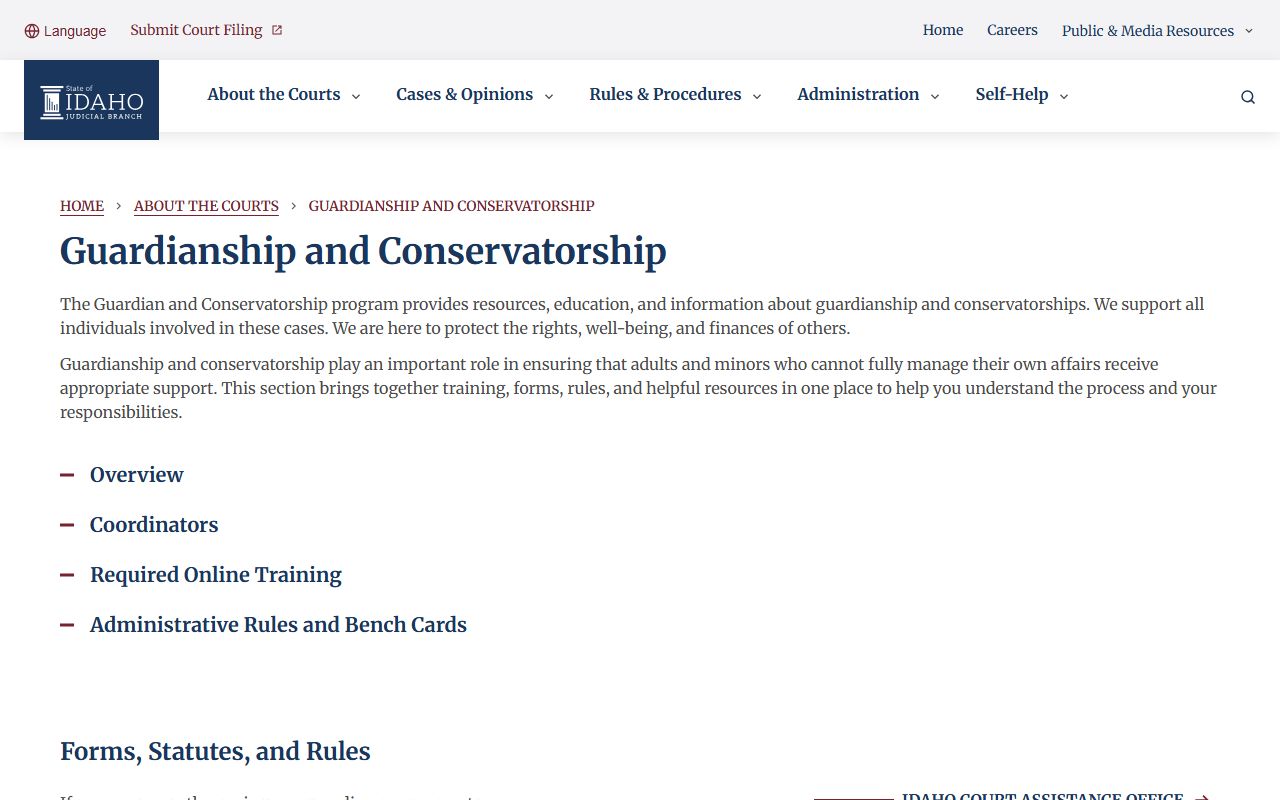
Training receipts and certificates can become part of the Fremont County guardianship or conservatorship case file.
Training fact: The course takes about 60 minutes, does not save progress, and does not run on phones or tablets.
Fremont County Estate Case Types
Idaho Court Assistance Office estate materials explain that probate is generally needed when title to property must be transferred. The process may be informal, formal, or summary administration. Informal probate may avoid hearings when the case is not contested. Formal probate is used when there are disputes about will validity, the personal representative, heirs, or distribution. Summary administration may be available when a spouse is the beneficiary.
Common Fremont County probate record types include applications, petitions, wills, notices, letters, bond requests, inventories, accountings, orders approving sale or compromise, final accounting, and orders of distribution. A person who needs to prove authority to act for an estate often needs letters testamentary or letters of administration rather than a full copy of every case filing.
| Probate item | What it shows |
|---|---|
| Will or codicil | The decedent's written estate directions when admitted to probate. |
| Application or petition | The request that opens informal probate, formal probate, or another estate proceeding. |
| Letters testamentary or administration | The representative's authority to act for the estate. |
| Inventory and accounting | Estate assets, activity, receipts, payments, and final handling. |
| Notice to creditors | Publication or notice steps tied to estate claims. |
| Final distribution order | The court-approved transfer or closing of estate property. |
Restricted Fremont County Probate Records
Not every probate-related record is fully public. Mental-health proceedings, minor guardianship information, protected personal identifiers, medical material, sealed entries, and sensitive financial details may be restricted or redacted. iCourt hearing filters may include probate or mental health, but access to the underlying record can still be limited by rule, statute, or court order.
For court records, Idaho Court Administrative Rule 32 is the main access rule. For noncourt county records, Idaho Public Records Law may apply, including request procedure and exemptions. If a Fremont County probate file includes both public and restricted material, the public copy may exclude protected parts while still showing nonconfidential case information.